Subscribe for clinical wellness insights, service updates, and exclusive offers — prescribed by GPs and delivered by AHPRA-registered nurses across Queensland & Northern Rivers NSW. Your Email Subscribe I agree and have read the FAQs.
Vitamin B6 is a serious workhorse nutrient. Its active form, PLP (pyridoxal-5′-phosphate), is involved in more than 100 enzyme reactions, especially amino acid metabolism, neurotransmitter production, haem synthesis, and homocysteine handling. If B6 status is poor, the fallout can show up in nerves, mood, skin, blood cells, and protein metabolism.

B6 is not just another generic “energy vitamin”. It is one of the central control nutrients for protein handling, neurotransmitter production, homocysteine metabolism, and haem synthesis. That is why deficiency can present with neurological symptoms, skin changes, mouth inflammation, anaemia, and low mood or irritability.
B6 deficiency can contribute to microcytic anaemia because PLP is required for haem synthesis. Haem is the iron-containing core of haemoglobin. So when B6 is low, oxygen-carrying capacity can suffer even if the problem is not just “lack of iron”.
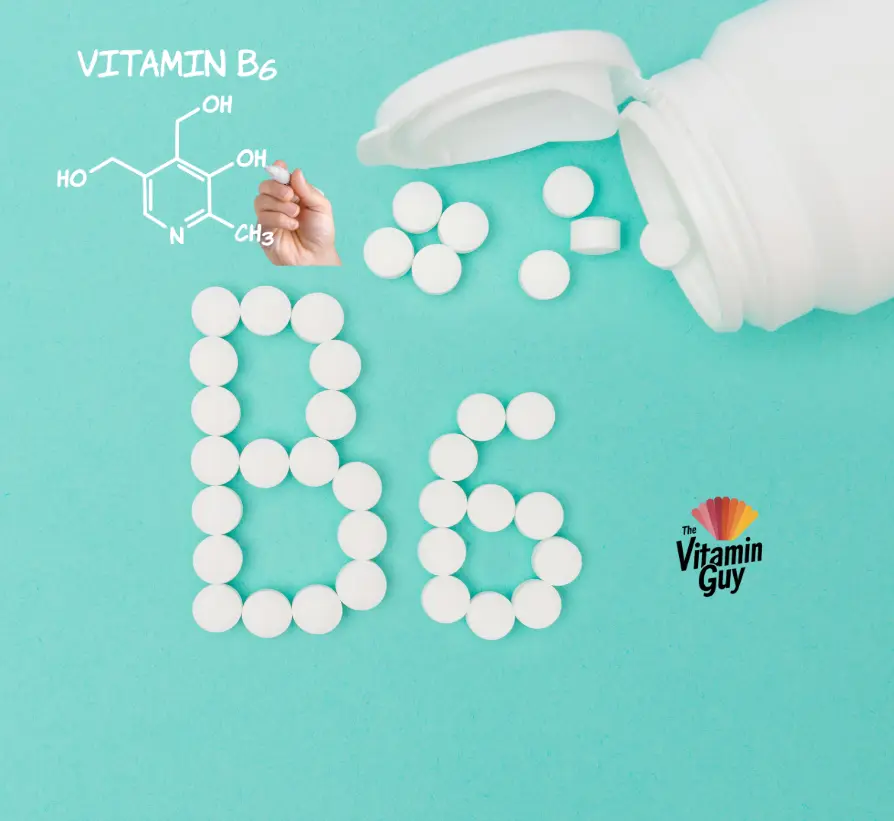
This is where precision matters. “Vitamin B6” is a family label, not a single molecule. The form affects function, food bioavailability, and the toxicity conversation.
| Form | What it is | Main context | Key note |
|---|---|---|---|
| Pyridoxine | Common supplemental form | Supplements and fortified foods | High-dose chronic use is the main form linked to sensory neuropathy risk |
| Pyridoxal | Natural vitamer | Food and metabolism | Converted into active coenzyme forms |
| Pyridoxamine | Natural vitamer | Food and metabolism | Part of the broader B6 pool |
| PLP (Pyridoxal-5′-phosphate) | Main active coenzyme form | Functional metabolism inside cells | The key biochemical form used by B6-dependent enzymes |
B6 absorption is usually decent in mixed diets, but not all sources are equal. Animal foods tend to provide more bioavailable forms, while some plant forms are partly bound as glycosides and can be less efficiently used.
Poultry, fish, organ meats, potatoes, bananas, chickpeas, and whole grains all contribute. In many everyday diets, potatoes and bananas genuinely matter more than people think.
| Food | Why it matters | B6 contribution pattern | Practical note |
|---|---|---|---|
| Poultry | Reliable high-contributor category | Strong | Common major source in omnivorous diets |
| Fish | Dense source with good protein value | Strong | Useful dual-purpose source of B6 and protein |
| Beef and liver | Rich animal-source contributors | Moderate to high | Liver is highly nutrient-dense but not something to smash daily |
| Potato | Major practical source in many diets | Moderate | Underrated contributor in real-world eating patterns |
| Banana | Accessible everyday food source | Modest | Not massive per serve, but useful because people actually eat it |
| Chickpeas | Important for mixed and plant-forward diets | Moderate | Useful for vegetarian patterns |
| Whole grains | Background contributor | Modest | Refining can reduce B-vitamin density |
Values vary by preparation, cut, species, and database entry. Use the Australian Food Composition Database when exact food-level numbers matter.
Chronic high-dose B6, especially pyridoxine above 100 mg/day, can cause sensory axonopathy — a stocking-glove neuropathy that can be slow to reverse and may at times be incomplete in recovery.
High-dose B6 is not a harmless “more is better” vitamin hack. There are legitimate supervised uses in specific clinical contexts, but blanket mega-dosing in healthy people is not evidence-based and can backfire badly.
B6 is essential, clinically relevant, and easy to underestimate. But there is a line between adequate intake and stupid overuse. Get enough. Do not megadose blindly.
These answers are written for readability, search relevance, and compliance. They explain normal nutrient roles and general safety without making disease-treatment claims.
Explore more educational content in the Learn Hub and Water-Soluble Vitamins section. © Cellular Intelligence Australia. All rights reserved. No part of this content may be reproduced without permission.
The Learn Hub is here to make nutrition, hydration, and IV therapy information easier to understand. If you have a question about how mobile IV therapy works, whether a service area is covered, or what to read next, you’re welcome to get in touch.
Important: Learn Hub pages are general educational content only. They are not personal medical advice, and IV nutrient therapy is only considered after independent GP assessment and prescription where clinically appropriate.