

Let’s Stay In Touch

Stay Informed. Stay Well.

Subscribe for clinical wellness insights, service updates, and exclusive offers — prescribed by GPs and delivered by AHPRA-registered nurses across Queensland & Northern Rivers NSW. Your Email Subscribe I agree and have read the FAQs.

Shopping cart

Evidence-informed • Australian context • Educational only • TGA-conscious

Manganese (Mn)

Manganese is an essential trace mineral needed in small amounts for antioxidant defence, bone and cartilage formation, connective tissue support, and the metabolism of carbohydrates, amino acids, and cholesterol. Deficiency in humans is rare, but excessive exposure can be harmful, particularly to the nervous system.

🔑 Core Function Supports enzyme activity involved in mitochondrial antioxidant defence, connective tissue, and metabolism.
🇦🇺 Australian Intake Adults use an Adequate Intake (AI): 5.5 mg/day for men and 5 mg/day for women.
🍽️ Main Sources Whole grains, legumes, nuts, seeds, tea, and leafy plant foods are major contributors.
⚠️ Real Risk Low manganese from food is uncommon. Excess is the bigger issue, especially from industrial exposure or unnecessary supplements.
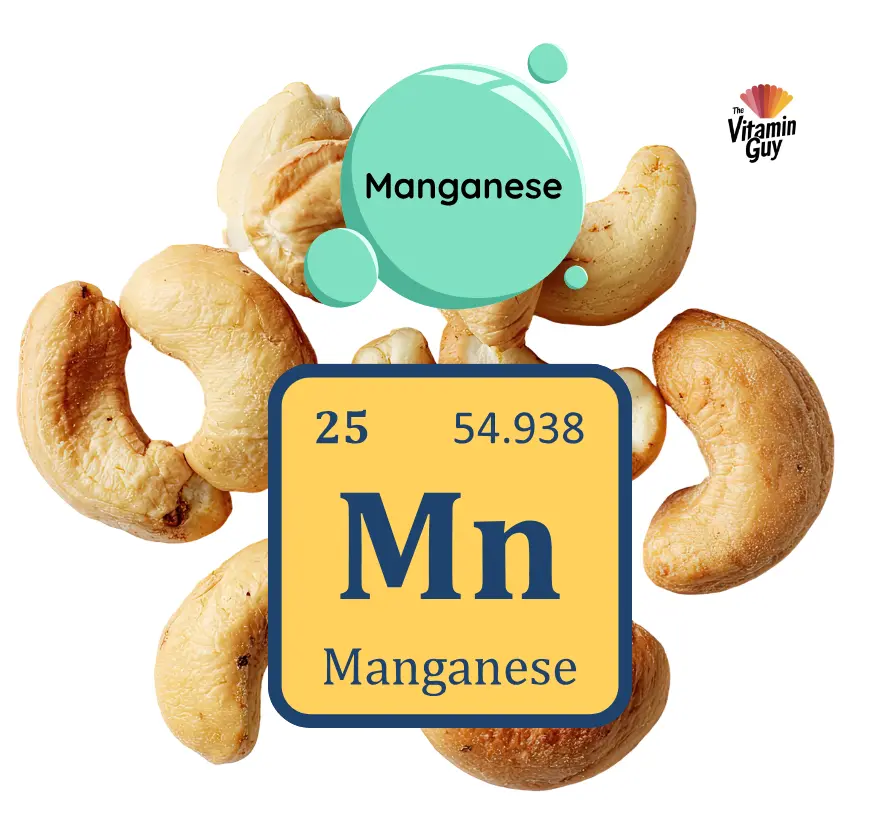
Manganese nutrient profile image for The Vitamin Guy Learn Hub
Manganese • Learn Hub • The Vitamin Guy

Manganese at a glance

Manganese does not get the attention that iron, zinc, or magnesium get, but it still matters. It sits quietly in the background of enzyme systems that help protect mitochondria, build connective tissue, and support normal metabolism.

Family Essential trace mineral
Main form Mn²⁺ acting as an enzyme cofactor
Food pattern Mainly plant-based sources such as grains, nuts, legumes, and tea
Clinical pearl Deficiency is rare in free-living humans; excess exposure is the bigger concern

What manganese does in the body

Antioxidant defence inside mitochondria

Manganese is a key part of manganese superoxide dismutase (Mn-SOD), an enzyme that helps protect mitochondria from oxidative stress. That matters because mitochondria are where cells generate energy, and they need protection from reactive oxygen by-products.

  • Supports mitochondrial antioxidant defence
  • Helps limit oxidative stress inside cells
  • Contributes to normal cellular resilience

Bone, cartilage, and connective tissue

Manganese contributes to enzymes involved in the formation of bone matrix, cartilage, and connective tissue. It is not the headline mineral for bone health, but it does play a supporting role.

  • Supports normal skeletal development
  • Helps maintain connective tissue pathways
  • Contributes to matrix-building enzymes

Metabolism of macronutrients

Manganese acts as a cofactor in enzymes involved in the metabolism of carbohydrates, amino acids, and cholesterol. In plain language, it helps the body process and use food efficiently.

  • Supports carbohydrate metabolism
  • Contributes to amino acid handling
  • Plays a role in lipid and cholesterol-related pathways

Wound healing and broader enzyme support

Because manganese is involved in multiple enzyme systems, it also contributes indirectly to tissue maintenance and recovery. It is a support mineral, not a superstar, but support minerals still matter.

  • Supports multiple enzyme systems
  • Helps connective tissue integrity
  • Contributes to normal tissue maintenance

Absorption, transport, and bioavailability

Main intake patternMostly from cereals, legumes, nuts, seeds, tea, and plant foods
Absorption efficiencyGenerally low and tightly regulated
Excretion routeMainly via bile
Clinical realityNormal diets usually provide enough

What can affect manganese absorption?

  • Higher iron intake can reduce manganese absorption because they share transport pathways.
  • High calcium intake may also reduce absorption in some settings.
  • Phytates in grains and legumes can bind manganese and reduce uptake.
  • Despite this, mixed diets still usually provide enough manganese for healthy people.

The blunt version: manganese deficiency from food alone is not common in everyday life.

Manganese-rich food sources

Manganese is found mainly in plant foods. That means whole-food eating patterns usually cover needs without much drama.

Food groupWhy it mattersTypical manganese contributionPractical note
Whole grainsOne of the main background sourcesModerate to highBetter contribution than refined grains
Nuts and seedsDense mineral source in small servesModerate to highEasy addition to oats, yoghurt, salads, and snacks
LegumesUseful plant-based contributorModerateAlso support fibre and broader mineral intake
TeaCan contribute meaningfully over timeModerateNot the only source, but it counts
Leafy vegetablesSupportive whole-food sourceLow to moderateBest seen as part of an overall dietary pattern
Plant-forward mixed dietsOften cover needs without supplementationSteadyVariety matters more than chasing a single “superfood”
Food-first reality check: manganese is not usually something healthy adults need to supplement. Normal whole-food intake is generally enough.

Australian Nutrient Reference Values (Manganese)

Australia uses an Adequate Intake (AI) for manganese rather than an RDI. That is the correct wording and it matters.

Men 19+ yearsAI: 5.5 mg/day
Women 19+ yearsAI: 5 mg/day
PregnancyAI: 5 mg/day
LactationAI: 5.5 mg/day
Upper levelNo UL set in AU/NZ due to limited data

What that means in practice

  • AI means estimated intake considered adequate when evidence is not strong enough to set an EAR and RDI.
  • No Australian UL does not mean unlimited safety.
  • Excess manganese can still be harmful, especially from industrial exposure or unnecessary supplementation.

No upper level listed is not a free pass to start taking random manganese pills.

Manganese deficiency and manganese excess

🚩 Deficiency

Manganese deficiency in humans is rare. When discussed in the literature, possible features include poor growth, skeletal changes, altered carbohydrate or lipid metabolism, and skin abnormalities. In real-world clinical practice, this is not commonly the first thing people are deficient in.

Practical point: low manganese from a standard mixed diet is uncommon. Deficiency is far less common than problems caused by excessive exposure.

⚠️ Excess

Excess manganese is the bigger concern. It is more likely to happen from industrial exposure, mining, welding, contaminated water, or supplement misuse than from ordinary food intake.

  • Can affect the nervous system
  • High exposure is associated with manganism, a neurotoxic syndrome
  • Food sources are generally safe; concentrated exposure is where things get messy
Do not guess with supplements: manganese is not a trendy “more is better” nutrient. Unnecessary supplementation is not smart.

Who may need exposure review?

  • Welders and industrial workers
  • People with occupational dust or fume exposure
  • Cases of possible contaminated environmental exposure
  • People self-prescribing stacked trace-mineral supplements

Who usually does not need supplements?

  • Healthy adults eating a varied diet
  • People already getting plenty of nuts, legumes, grains, and plant foods
  • Anyone supplementing “just because”

What gets misunderstood

  • No UL listed does not equal no risk
  • Ordinary foods are not the main toxicity issue
  • Trace minerals still need balance, not hype

Testing and monitoring manganese status

Manganese testing is not especially useful for everyday nutrition screening. Context matters more than chasing isolated numbers.

Test or approachWhat it may showMain limitationWhen it may matter
Blood manganeseRecent exposure levelNot a reliable marker of normal nutritional statusExposure or occupational assessment
Urine manganesePossible recent exposure contextLimited usefulness for routine nutritionSelected toxicology or exposure review
Exposure historyOften more clinically useful than routine labsDepends on accurate history and contextOccupational health or environmental concerns
General clinical reviewHelps separate diet questions from toxicity concernsNot specific on its ownWhen supplement use or environmental exposure is suspected
Bottom line: manganese assessment is usually more about exposure risk than routine deficiency testing.

Interactions and supplementation common sense

Iron, calcium, and competition

Iron and manganese share transport pathways, so higher iron intake can reduce manganese absorption. High calcium intake may also reduce uptake in some cases.

  • Minerals can compete with each other
  • More of one does not automatically improve the whole system
  • Balance matters more than stacking pills

Phytates and whole-food reality

Phytates in grains and legumes can reduce manganese absorption, but in practice, whole-food diets still usually provide enough manganese. Normal eating patterns are rarely the problem.

  • Whole foods still make sense
  • Do not overreact to every absorption nuance
  • The bigger risk is unnecessary supplement exposure, not oats

Minerals hub

Explore the broader mineral library and see how trace minerals fit together.

Visit the Minerals hub

Zinc

Helpful for understanding why trace-mineral balance matters more than random supplement stacking.

Read the Zinc page

Manganese FAQs

What does manganese do in the body?

Manganese supports antioxidant defence, connective tissue and bone formation, and enzyme systems involved in carbohydrate, amino acid, and cholesterol metabolism.

Is manganese deficiency common?

No. Manganese deficiency is considered rare in humans, especially in people eating a mixed diet.

What foods contain manganese?

Whole grains, legumes, nuts, seeds, tea, and many plant foods contribute manganese to the diet.

Is manganese supplementation usually needed?

Not usually. Most healthy adults can meet manganese needs through food. Supplement use should have a real reason, not just guesswork.

Can too much manganese be harmful?

Yes. Excess manganese exposure can affect the nervous system, especially in occupational or environmental exposure settings or with unnecessary supplement misuse.

Are blood tests useful for manganese status?

Not for routine nutrition screening. Blood or urine manganese are generally more relevant for exposure assessment than for everyday dietary evaluation.

Learn before you supplement

Manganese is a background support mineral, not a hype nutrient. Most people do not need a supplement. Food-first makes more sense than blindly stacking trace minerals.

Important: This page is educational and does not replace individual medical advice. Any discussion of nutrients on this site is general information only. Where prescription care is relevant, independent GP assessment and clinical judgement come first.

References and further reading

  1. NHMRC / Eat for Health. Manganese — Nutrient Reference Values for Australia and New Zealand. https://www.eatforhealth.gov.au/nutrient-reference-values/nutrients/manganese
  2. NIH Office of Dietary Supplements. Manganese Fact Sheet. https://ods.od.nih.gov/factsheets/Manganese-HealthProfessional/

TGA-conscious educational wording: this content describes normal physiological roles, nutrition context, and general health education only. It does not claim to diagnose, treat, cure, or prevent disease.