Subscribe for clinical wellness insights, service updates, and exclusive offers — prescribed by GPs and delivered by AHPRA-registered nurses across Queensland & Northern Rivers NSW. Your Email Subscribe I agree and have read the FAQs.
Mineral GuideAustralian ContextEvidence-InformedTGA-Safe Education
Calcium (Ca²⁺)
Calcium is best known for helping build and maintain bones and teeth, but that is only part of the story.
It also helps the body with muscle contraction, nerve signalling, blood clotting,
and cell communication. Whether calcium actually gets absorbed and used well depends heavily on the bigger picture:
vitamin D status,
food pattern, gut factors, age, and the form of calcium being consumed.
🦴 Where it livesAbout 99% of body calcium is stored in bones and teeth, with the rest tightly regulated in blood and tissues.
☀️ Key partnerVitamin D helps the gut absorb calcium more efficiently.
⚠️ Common mistakePeople often focus only on intake, while ignoring absorption, food quality, and whether supplements are even needed.
Educational calcium overview for The Vitamin Guy Learn Hub. General information only — not personal medical advice.
Quick Facts
Calcium is a macro mineral and an essential nutrient. In the body it exists both as a structural mineral
in hydroxyapatite and as free ionised calcium (Ca²⁺), which is the biologically active form that cells use for signalling.
🧬 Family & essentiality
Mineral classMacro mineral
EssentialityEssential
Main body poolBone and teeth
Active circulating formIonised calcium (Ca²⁺)
⚗️ Forms you’ll see
Food calcium: naturally present in dairy, fish with bones, some greens, tofu, and fortified foods
Bone calcium: mostly stored as hydroxyapatite with phosphorus
Supplement forms: carbonate, citrate, phosphate, lactate, gluconate and others
🇦🇺 Australian NRV snapshot
Adults 19–501000 mg/day
Women 51+1300 mg/day
Men 70+1300 mg/day
UL adults2500 mg/day
Reality check: more calcium is not automatically better. The goal is adequate intake from a balanced pattern,
with supplements used carefully where clinically appropriate.
What Calcium Actually Does
🦴 Structural role
Calcium combines with phosphorus to form hydroxyapatite, the mineral matrix that gives bones and teeth hardness and strength.
💪 Muscle contraction
Calcium is required for normal muscle contraction, including skeletal muscle, smooth muscle, and the heart.
🧠 Nerve signalling
It helps nerves release neurotransmitters and supports rapid electrical and chemical communication between cells.
🩸 Clotting support
Calcium acts as a cofactor in parts of the coagulation cascade, which is why normal calcium balance matters for haemostasis.
📡 Cell signalling
Calcium acts as a second messenger inside cells, helping regulate secretion, contraction, excitability, and signalling pathways.
⚖️ Tight regulation
Blood calcium is tightly controlled by parathyroid hormone (PTH), vitamin D status, kidney handling, and bone turnover.
Absorption, Bioavailability & Supplement Forms
Calcium absorption is not just about the number on the label. Form, meal timing, stomach acid, vitamin D status, total dose,
and the food matrix all matter.
Splitting larger doses instead of taking everything at once
Using calcium citrate when stomach acid is lower
Choosing lower-oxalate greens such as bok choy or kale instead of relying on spinach
⬇️ What may reduce effective absorption
Low vitamin D status
Large single supplemental doses
High-oxalate foods like spinach and rhubarb
High-phytate meal patterns in some grains and legumes
Low stomach acid, which matters more for calcium carbonate than calcium citrate
Supplement form comparison
Form
Best known for
Useful note
Elemental calcium
Calcium carbonate
Higher elemental calcium per gram
Usually best taken with food; may be less ideal with low stomach acid or PPIs
~40%
Calcium citrate
Less dependent on stomach acid
Often preferred when gastric acid is low; can be taken with or without food
~21%
Calcium phosphate
Included in some mixed formulas
Supplies both calcium and phosphate
Varies
Lactate / gluconate
Lower elemental calcium
Used in some specialised products; often less calcium per tablet
Lower
The exact “best” form depends on tolerance, dose, stomach acid, meal timing, and whether dietary calcium is already adequate.
Practical tip: chasing huge doses is usually not the smart move. Moderate intake spread through food and sensible dosing
is often a better strategy than swallowing massive single-dose tablets.
Best Food Sources of Calcium
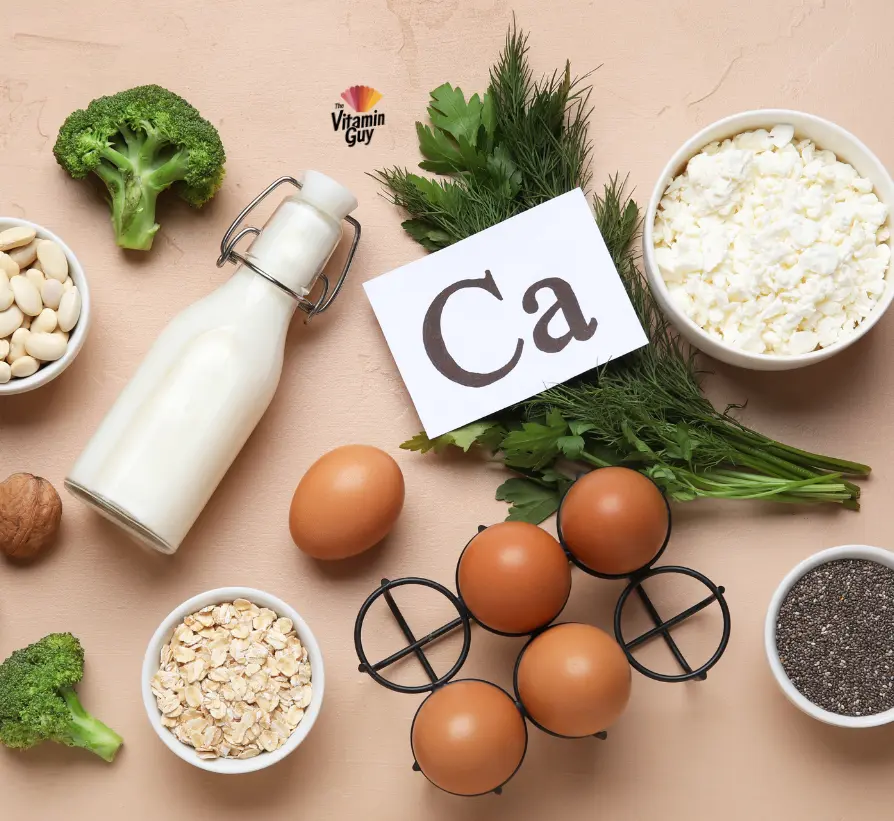
Dairy foods remain major contributors in Australia, but calcium can also come from fortified plant milks, tofu set with calcium salts,
fish with edible bones, and selected greens. Bioavailability matters, not just raw milligram counts.
Food source
Why it matters
Key note
Typical calcium contribution
Milk, yoghurt, cheese
Reliable, dense sources
Often major contributors to intake in mixed diets
Moderate to high
Fortified plant milks
Useful dairy alternative
Check the label; calcium content varies between brands
Variable
Tofu set with calcium salts
Strong non-dairy option
Not all tofu is equal; calcium-set tofu is the one to look for
Moderate to high
Sardines / salmon with bones
Calcium plus protein
Edible bones are the key part
High
Bok choy / kale
Useful greens
Generally better absorbed than high-oxalate spinach
Low to moderate
Spinach
Contains calcium
High oxalate means absorption is relatively poor
Misleading on paper
🥛 Good foundations
Dairy foods if tolerated
Fortified plant beverages with verified calcium content
Calcium-set tofu
Fish with edible bones
🌿 Food matrix matters
A food can look “high calcium” on paper but still be poorly absorbed
Leafy greens are not all equal
Fortified foods need label checking, not guessing
Australian Intake Targets
The official Australian and New Zealand Nutrient Reference Values list adult targets that change with life stage and age.
NRV snapshot
Adults 19–501000 mg/day
Women 51+1300 mg/day
Men 70+1300 mg/day
Visual bars are for quick comparison only. Adults UL: 2500 mg/day.
Who may need more attention?
Post-menopausal women
Older adults
People avoiding dairy without a strong replacement plan
People with chronically low vitamin D status
People with malabsorption issues or restrictive diets
Low Calcium Status, Deficiency & Excess
⬇️ Low intake / low status
Short-term blood calcium is tightly regulated, so a poor diet does not always show up dramatically in a routine blood test straight away.
Over time, however, low intake can contribute to reduced bone mineral density, osteopenia, osteoporosis, and higher fracture risk.
Possible clues
Low habitual calcium intake
High fracture risk context
Secondary hyperparathyroidism in some cases
Muscle cramps or neuromuscular symptoms in more severe low-calcium states
⬆️ Excess / overdoing supplements
Excess calcium is more likely to come from heavy supplement use than from normal food intake. Too much can raise the risk of
constipation, hypercalcaemia in susceptible cases, and kidney stone issues in some people.
Red flags
High-dose self-prescribing without indication
Stacking multiple products unknowingly
Using supplements without checking vitamin D, diet, or kidney stone history
Important: calcium supplements are not “harmless just because they’re common”.
The right dose depends on the person, the diet, the form used, and the clinical context.
Testing & Monitoring
A single calcium number does not tell the whole story. Interpretation often depends on albumin, symptoms, vitamin D, PTH, kidney function,
and the actual question being asked.
🧪 Common tests
Serum calcium
Albumin-corrected calcium
Ionised calcium
🔎 Useful companion tests
25-hydroxyvitamin D
Parathyroid hormone (PTH)
Kidney function markers
Phosphate and magnesium in selected cases
🪨 Selected extra work-up
Urinary calcium in some kidney stone or metabolic workups
Bone density assessment when clinically appropriate
Better approach: ask “what problem are we trying to answer?” before throwing calcium tablets at the situation.
Sometimes the issue is actually vitamin D, low energy intake, poor diet quality, low protein intake, gut factors, or bone turnover risk.
Vitamin K₂ is relevant to calcium handling in bone and soft tissues
Magnesium is often part of the broader conversation around muscle function and bone health
⏱️ Timing & medication spacing
Calcium can interfere with absorption of some iron, zinc and certain antibiotics
Spacing may matter depending on the medicine or mineral involved
Thiazide diuretics can raise calcium; loop diuretics can lower it
Evidence Snapshot
✅ Well established
Essential for bone and teeth structure
Needed for muscle and nerve function
Supports normal clotting pathways
⚖️ More nuanced
Supplement benefits depend on baseline diet, age, deficiency risk, and total context
Not every healthy adult needs a calcium supplement
❌ Hype to avoid
“More is always better” thinking
Using large doses as a blanket wellness strategy
Assuming a tablet fixes weak diet quality
Frequently Asked Questions
What is calcium mainly used for in the body?
Calcium helps build and maintain bones and teeth, but it also supports muscle contraction, nerve signalling, blood clotting,
and cellular communication.
Is calcium only about bones?
No. Bone is the biggest storage site, but calcium also has critical roles in muscles, nerves, clotting, and intracellular signalling.
Does vitamin D matter for calcium absorption?
Yes. Vitamin D status strongly influences how effectively the gut absorbs calcium.
Is spinach a great calcium source?
Not as great as many people think. Spinach contains calcium, but its high oxalate content reduces how much is effectively absorbed.
What is the difference between calcium carbonate and calcium citrate?
Calcium carbonate has more elemental calcium per gram, but it relies more on stomach acid and is usually taken with food.
Calcium citrate has less elemental calcium, but is less dependent on stomach acid and can suit some people better.
Should everyone take a calcium supplement?
No. Many people can meet needs through food. Supplements should match the person, diet, risk profile, and clinical context.
Can too much calcium be a problem?
Yes. Excessive supplemental calcium can contribute to constipation, hypercalcaemia in susceptible cases, and kidney stone issues in some people.
What tests are useful if calcium issues are suspected?
Depending on context, testing can include serum calcium, albumin-corrected calcium, ionised calcium, vitamin D, PTH, kidney function,
and sometimes urinary calcium.
Keep Learning
Calcium does not work in isolation. The broader picture often includes vitamin D, magnesium, vitamin K₂, protein intake,
overall diet quality, and clinical context.
TGA-compliant note: This page is educational and describes normal physiological roles of calcium and general nutrition concepts.
It does not claim to diagnose, treat, cure, or prevent disease. Independent assessment by a qualified healthcare professional is recommended for personalised advice.