Let’s Stay In Touch

Stay Informed. Stay Well.

Subscribe for clinical wellness insights, service updates, and exclusive offers — prescribed by GPs and delivered by AHPRA-registered nurses across Queensland & Northern Rivers NSW. Your Email Subscribe I agree and have read the FAQs.

Shopping cart

Evidence-informed Australian context SEO-optimised TGA-safe educational wording

Vitamin B1 (Thiamine / Thiamin)

Vitamin B1 is a water-soluble B-vitamin your body needs to turn carbohydrate into usable energy, support healthy nerve function, and keep high-demand tissues like the brain, heart, and muscles running properly.

🔑 Core Function Helps convert food into ATP by supporting key energy-producing enzymes.
🧠 High-demand tissues Especially important for the brain, nerves, and heart because these tissues rely heavily on glucose metabolism.
⚠️ Deficiency matters Low status can affect nerves, cognition, appetite, balance, and in severe cases the cardiovascular system.
🇦🇺 Australian relevance Australia mandates thiamin fortification of wheat flour for bread-making, but deficiency can still occur in at-risk groups.

General educational information only. This page discusses normal physiological roles, food sources, deficiency risk, and testing logic. It does not diagnose, treat, cure, or prevent disease, and it is not a substitute for personalised medical advice.


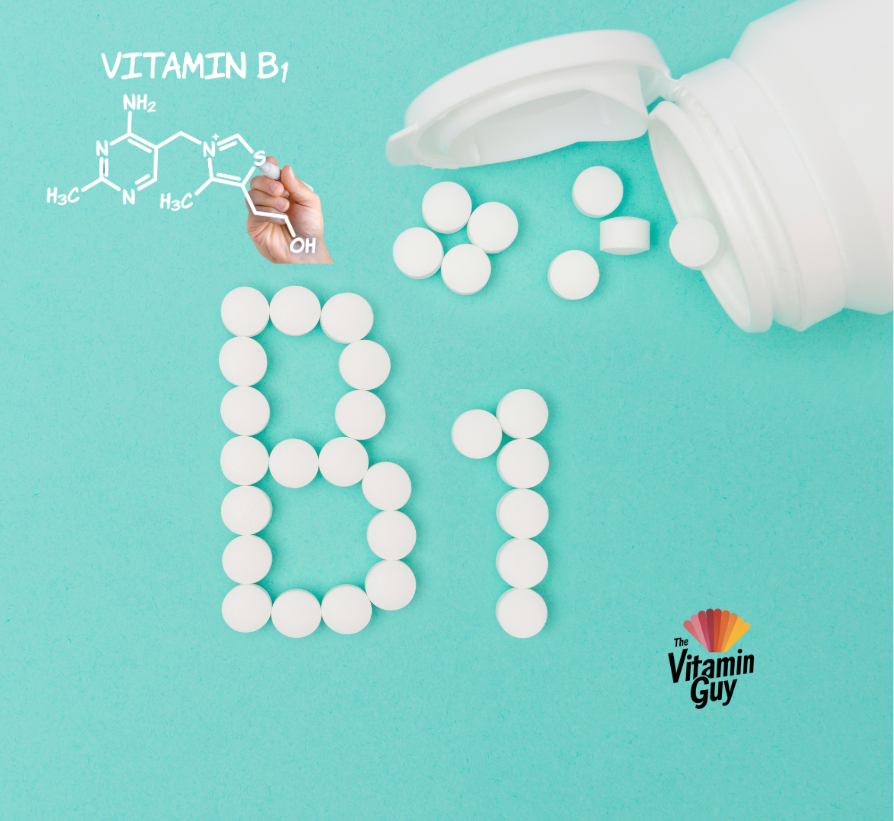
Vitamin B1 thiamine educational profile by The Vitamin Guy for Brisbane, Gold Coast and Northern Rivers NSW
Vitamin B1 educational guide • The Vitamin Guy
Vitamin family Water-soluble B-vitamin
Active form TPP / ThDP (thiamine pyrophosphate / thiamine diphosphate)
Australian adult RDI Men 1.2 mg • Women 1.1 mg
Upper level No UL established

What Vitamin B1 Actually Does

Thiamine is not a glamour nutrient. It is a core metabolic nutrient. If it is low, the body struggles to run glucose through key energy pathways properly. That is why deficiency tends to hit the nervous system, cognition, coordination, and in some cases the heart.

🧬 Family & forms

NameVitamin B1, thiamine, thiamin
EssentialityEssential — must be obtained from food because the body stores only small amounts
Main active formTPP / ThDP — the coenzyme form used in energy metabolism
Other formsTMP (thiamine monophosphate), free thiamine, synthetic supplemental salts such as thiamine hydrochloride

⚗️ Chemical snapshot

  • Base molecule: thiamine contains sulfur and nitrogen in a positively charged structure.
  • Water-soluble: regular intake matters because body reserves are limited.
  • Fragile nutrient: heat, alkaline conditions, sulphites, and processing can reduce thiamine content.
  • Food handling note: refinement strips thiamine from grains unless the food is enriched or fortified.

🌿 Plain-language summary

Vitamin B1 helps your body unlock energy from food. It is especially important when you eat carbohydrate because thiamine-dependent enzymes help shuttle glucose into pathways that let cells produce energy properly.

When thiamine is low, tissues with high energy demand suffer first. That is why symptoms can include fatigue, poor concentration, irritability, numbness, weakness, poor balance, appetite loss, and in severe deficiency, confusion or cardiac strain.

⚡ Key biochemical roles

Enzyme / pathwayWhy it mattersOutcome
Pyruvate dehydrogenaseLinks glycolysis to the citric acid cycleCritical for ATP production from carbohydrate
Alpha-ketoglutarate dehydrogenaseSupports the citric acid cycleFurther energy extraction inside mitochondria
Branched-chain alpha-ketoacid dehydrogenaseHelps process branched-chain amino acidsSupports broader fuel metabolism
TransketolaseWorks in the pentose phosphate pathwayHelps generate NADPH and ribose for cell function and repair

Bottom line: B1 is foundational for cellular energy, carbohydrate handling, and nervous-system support.

🧠 Why the brain cares

  • The brain depends heavily on glucose metabolism.
  • Low thiamine can impair energy production in neurons.
  • That is why severe deficiency can affect memory, coordination, attention, and mental status.
  • It also helps support normal nerve signalling and neuromuscular function.

Australian Intake Targets, Food Sources & Absorption

Thiamine requirements are not huge, but they are steady. Intake matters more when carbohydrate intake is high, food quality is poor, alcohol use is heavy, or absorption is compromised.

🇦🇺 Australian NRVs

Life stageRDI / AIUnits
Adult men1.2mg/day
Adult women1.1mg/day
Pregnancy1.4mg/day
Lactation1.4mg/day

No Upper Level of Intake has been established for thiamin in the Australian NRV framework.

🍞 Australian food-system note

In Australia, wheat flour for making bread must be fortified with thiamin. That improves baseline intake across the population, but it does not eliminate deficiency risk in people with alcohol dependence, poor dietary intake, malabsorption, chronic vomiting, bariatric surgery, or high losses.

Useful reality check: fortification helps, but it is not magic. A person can still become functionally low in thiamine if intake is poor, absorption is impaired, or requirements and losses are higher than usual.

🥗 Better food sources of vitamin B1

Food groupExamplesWhy it matters
PorkPork loin, lean pork cutsOne of the better naturally rich food sources of thiamine
Wholegrains & enriched grainsWholegrain breads, fortified breakfast cereals, enriched grain foodsUseful population-level source, especially in Australia
LegumesLentils, beans, peasHelpful plant-based source and useful for mixed meals
Nuts & seedsSunflower seeds, macadamias, mixed seedsCan contribute meaningfully when eaten regularly
Yeast-based foodsNutritional yeast, yeast spreadsOften concentrated sources depending on product
Organ meatsLiver and some offal productsCan provide thiamine plus multiple other B-vitamins

Food values vary by cultivar, processing, fortification status, cooking method, and serve size. Refined grains generally contain less thiamine unless enriched or fortified.

🍽️ Absorption & bioavailability

  • At usual dietary intakes, thiamine is absorbed efficiently in the small intestine.
  • Absorption is saturable, so mega-dosing does not translate into endlessly higher uptake.
  • Mixed diets and fortified foods can help maintain status.
  • Body stores are limited, so prolonged low intake matters.

⬇️ What can lower status

  • Alcohol dependence or heavy chronic alcohol use
  • Poor overall dietary intake
  • Persistent vomiting or severe nausea
  • Bariatric surgery or malabsorption states
  • Dialysis
  • Prolonged diuretic use in some people
  • High refined-food diets with low nutrient density
  • Sulphite exposure reducing thiamine in certain foods

Deficiency, Risk Groups & Clinical Red Flags

Mild low thiamine status can be vague. Severe deficiency is not vague at all. It can become neurologically or cardiovascularly dangerous. That is why early recognition matters in genuinely at-risk groups.

🚨 Deficiency signs

Early / non-specific

  • Fatigue and low energy
  • Irritability or poor concentration
  • Reduced appetite
  • Weakness

Neurological

  • Peripheral neuropathy
  • Numbness, tingling, burning feet, or reduced reflexes
  • Unsteady gait or poor coordination
  • Confusion or cognitive change in severe cases

Cardiovascular

  • Tachycardia
  • Shortness of breath
  • Fluid retention / oedema
  • Signs consistent with wet beriberi in severe deficiency

🩺 Classic deficiency patterns

  • Dry beriberi: predominantly neurological — weakness, neuropathy, gait issues.
  • Wet beriberi: predominantly cardiovascular — oedema, cardiac strain, high-output failure picture.
  • Wernicke’s encephalopathy / Wernicke-Korsakoff spectrum: severe thiamine deficiency affecting the brain, most classically associated with alcohol dependence but not limited to it.
Important: suspected severe thiamine deficiency is not a casual “just take a multivitamin” situation. Confusion, ataxia, vomiting, malnutrition, or alcohol-related risk with neurological signs needs proper medical assessment.

👥 Higher-risk groups

GroupWhy risk may be higherCommon trigger to think about testing or treatment
People with alcohol dependenceLower intake, reduced absorption, impaired storage and phosphorylationConfusion, gait change, neuropathy, poor intake, vomiting
Post-bariatric surgeryReduced intake plus malabsorption riskPersistent vomiting, weakness, numbness, neurological change
Dialysis patientsLosses plus higher clinical complexityLow intake, frailty, unexplained fatigue or neuropathy
Older adults with poor intakeLower dietary diversity, illness burden, polypharmacyWeight loss, frailty, confusion, poor appetite
Persistent vomiting / hyperemesis statesLow intake and rapid depletionWeight loss, weakness, dizziness, neurological symptoms
People with very poor diet qualityLow nutrient density despite adequate caloriesFatigue with low-quality high-refined-food intake

Testing, Interpretation & Interactions

Thiamine is not the easiest nutrient to assess from a simple serum number alone. Clinical context matters, and where deficiency is strongly suspected, treatment should not be delayed while waiting around for perfect paperwork.

🧪 Better testing options

  • Whole-blood or erythrocyte thiamine diphosphate (ThDP / TPP): commonly regarded as the more useful marker of status.
  • Erythrocyte transketolase activity coefficient (ETKAC): functional assessment used in some settings.
  • Serum or plasma thiamine: can be less informative than intracellular markers.
Clinical pearl: if someone is high-risk and symptomatic, testing is useful, but the clinical picture still matters.

🔗 Important interactions

  • Alcohol: reduces absorption and worsens deficiency risk.
  • Diuretics: chronic use can contribute to depletion in some patients.
  • Sulphites: can degrade thiamine in food.
  • Raw freshwater fish or shellfish: may contain thiaminases that destroy thiamine; cooking inactivates these enzymes.

📊 Evidence snapshot

TopicEvidence strengthPlain-English take
Energy metabolismStrongEstablished biochemical role. This is not hype.
Nerve and neurological supportStrongDeficiency clearly impairs neurological function.
Use in true deficiency statesStrongClear clinical importance, especially in high-risk settings.
High-dose use in healthy people for “more energy”Weak / inconsistentBig claims are usually marketing, not hard evidence.

Vitamin B1 FAQs

Straight answers to the questions people actually ask.

What is vitamin B1 good for?
Vitamin B1 helps your body convert food into energy and supports normal nervous-system function. It is especially important for carbohydrate metabolism and for high-energy tissues like the brain, heart, and muscles.
What happens if you are low in vitamin B1?
Low vitamin B1 can cause fatigue, poor appetite, irritability, weakness, numbness, tingling, reduced balance, and in more serious cases neurological or cardiovascular problems. Severe deficiency can become urgent.
Who is more likely to become deficient in thiamine?
Higher-risk groups include people with alcohol dependence, poor dietary intake, bariatric surgery, chronic vomiting, dialysis, and some older adults with low food intake or multiple medical issues.
Can you get enough vitamin B1 from food?
Usually yes, especially with a varied diet that includes pork, legumes, nuts, seeds, wholegrains, and fortified grain foods. But food sufficiency depends on intake quality, absorption, losses, and health status.
Is there a toxicity risk from vitamin B1?
Toxicity from food is not a known issue, and no Upper Level has been established for thiamin in the Australian NRV framework. That does not mean random high-dose supplement use is automatically useful.
What is the best test for vitamin B1?
Whole-blood or erythrocyte thiamine diphosphate is generally more informative than a simple serum level. Functional testing such as erythrocyte transketolase may also be used in some settings.

Keep Exploring

If you are building a stronger nutrition foundation, do not look at thiamine in isolation. B-vitamins work as a network, and overall dietary quality still matters more than supplement hype.

References & Further Reading

  1. National Health and Medical Research Council (NHMRC). Nutrient Reference Values for Australia and New Zealand – Thiamin. nrv.gov.au
  2. Food Standards Australia New Zealand (FSANZ). Thiamin fortification. foodstandards.gov.au
  3. Office of Dietary Supplements, National Institutes of Health. Thiamin – Health Professional Fact Sheet. ods.od.nih.gov
  4. Food Standards Australia New Zealand (FSANZ). Australian Food Composition Database. foodstandards.gov.au
TGA-safe wording note: this page is educational. It describes normal nutrient physiology, dietary sources, deficiency risk, and assessment concepts. It does not make therapeutic claims.