Subscribe for clinical wellness insights, service updates, and exclusive offers — prescribed by GPs and delivered by AHPRA-registered nurses across Queensland & Northern Rivers NSW. Your Email Subscribe I agree and have read the FAQs.
A practitioner-grade overview of vitamin K₂: the major forms, where they are found, how they behave differently from K₁, what matters for bone and vascular physiology, and why supplement hype needs to be handled carefully.
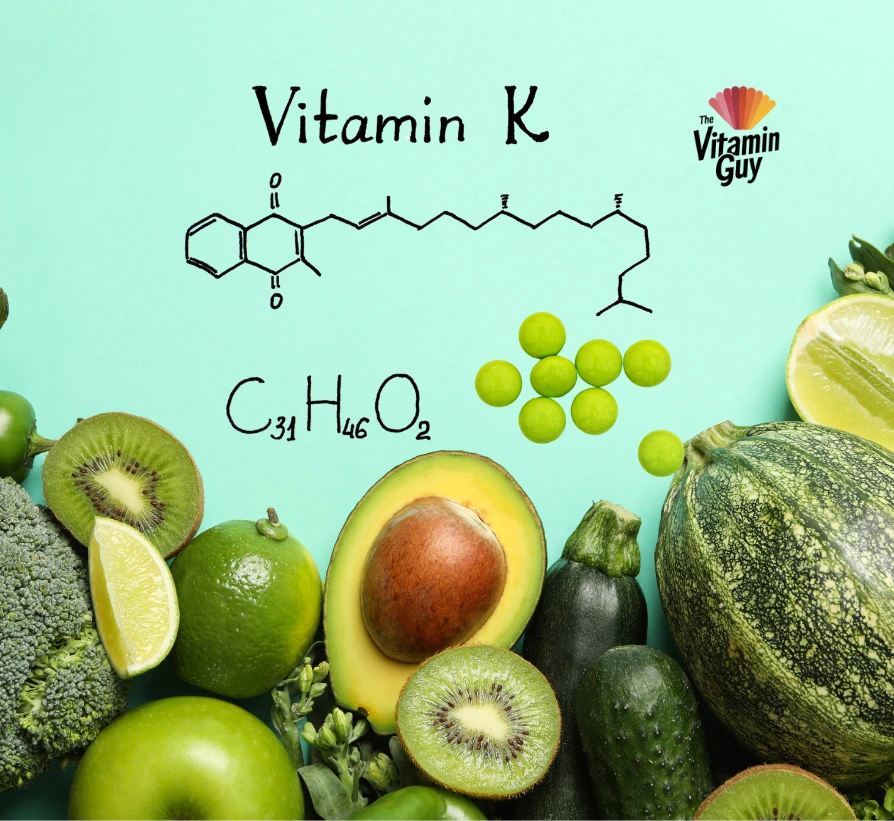
🔑 Core Function: Vitamin K₂ is part of the vitamin K family and helps activate vitamin K–dependent proteins outside the liver, including proteins involved in normal bone physiology and vascular tissue biology. It shares core carboxylation biology with K₁, but the forms and tissue distribution are not identical.

The clean version first. Then the deeper breakdown below.
Australia does not set a separate NRV specifically for K₂. It sits within total vitamin K intake guidance.
Vitamin K₂ helps activate proteins involved in how the body handles calcium in normal physiology. That is why it gets discussed in bone and vascular conversations. The problem is that the internet usually turns that into exaggerated promises.
Good nutrient, real biology, too much marketing nonsense around it.
Not all K₂ forms behave the same. This matters.
MK-4 and MK-7 are not interchangeable just because both are called K₂.
They differ in food sources, pharmacokinetics, and how they are used in supplement products. A lot of content online blurs that distinction and ends up being half-right at best.
| Form | Name | Chemical formula | Common discussion point | Practical note |
|---|---|---|---|---|
| MK-4 | Menaquinone-4 | C31H40O2 | Shorter half-life | Often discussed separately from MK-7 because kinetics differ |
| MK-7 | Menaquinone-7 | C46H64O2 | Longer half-life | Common in natto-related conversations and many supplement products |
| MK-8 / MK-9 | Longer-chain menaquinones | Varies by chain length | Less commonly marketed directly | Usually enter the discussion via fermented foods and cheeses |
What K₂ is actually doing, not what influencer captions say it is doing.
Do not turn “supports normal calcium handling” into wild claims.
It is reasonable to discuss K₂ in relation to normal bone and vascular physiology. It is not reasonable to market it as a guaranteed artery cleaner, anti-ageing miracle, or cancer-prevention shortcut.
This is where form differences start to matter more.
Simple rule: if K₂ is consumed in a totally fat-free context, you are not helping absorption. Pair with a meal.
K₂ food sources are real, but most people do not eat them in huge amounts.
| Food group | Examples | Main K₂ form focus | Practical note | Real-world relevance |
|---|---|---|---|---|
| Fermented soy | Natto | Mostly MK-7 | One of the most famous concentrated food sources | Very useful nutritionally, but many people will not eat it regularly |
| Animal foods | Egg yolks, chicken, some meats | Mostly MK-4 discussion | Can contribute modest amounts in mixed diets | More realistic than natto for many Western eating patterns |
| Dairy | Cheese, butter, some fermented dairy | Variable; may include MK-4, MK-8, MK-9 depending on food | Food composition can vary substantially | Contributes, but usually not a reason to over-romanticise cheese |
| Fermented cheeses | Some hard and aged cheeses | MK-8 / MK-9 often discussed | Interesting source, but intake patterns differ a lot | More of a contributor than a universal solution |
K₂ food composition is more variable and less straightforward than the leafy-green K₁ story. That is part of why supplement discussion around K₂ became so popular.
True K₂-specific deficiency is not something most people can identify neatly from symptoms alone.
There is a lot of talk online about hidden K₂ deficiency causing everything under the sun. Most of that is overreach.
The real question is not “does everyone secretly have K₂ deficiency?” It is “does this person’s intake, absorption, medication profile, and clinical context make vitamin K status worth reviewing?”
No simple mainstream consumer test neatly tells you “your K₂ is low”.
This section matters more than supplement marketing.
| Medication / factor | What matters | Risk / issue | Practical guidance |
|---|---|---|---|
| Warfarin / vitamin K antagonists | K₂ intake can influence anticoagulant effect | Supplement use or major intake shifts may interfere with management | Do not add K₂ casually; follow prescribing clinician advice |
| Broad-spectrum antibiotics | May alter microbial contribution and overall vitamin K context | Status may be more vulnerable in prolonged or complex cases | Look at diet, symptoms, absorption, and clinical context together |
| Orlistat | Reduces fat absorption | Can reduce absorption of fat-soluble vitamins including K forms | Medication review matters |
| Bile acid sequestrants | Can impair fat-soluble vitamin absorption | May reduce vitamin K absorption over time | Review symptoms, diet and medication plan with clinician |
| Very low-fat intake | Reduces absorption opportunity | Can undermine food or supplement efficiency | Take K₂ with a meal containing some fat |
K₂ is not a casual add-on for people on warfarin.
Because vitamin K antagonists work by interfering with vitamin K recycling, adding a K₂ supplement without proper oversight can create management problems. This is not a DIY space.
Related, but not the same discussion.
| Feature | Vitamin K₂ (Menaquinones) | Vitamin K₁ (Phylloquinone) |
|---|---|---|
| Main food pattern | Fermented foods, some cheeses, animal foods depending on form | Leafy greens, herbs, cruciferous vegetables, plant oils |
| Main public discussion | Bone and vascular physiology conversations | Clotting and dietary consistency, especially with warfarin |
| Common supplement focus | MK-4 and MK-7 | Less commonly the headline supplement form in mainstream wellness marketing |
| Shared biology | Vitamin K–dependent carboxylation | Vitamin K–dependent carboxylation |
| Main mistake people make | Overhyping it | Oversimplifying it to “just clotting” |
For the K₁ page, use: Vitamin K₁ (Phylloquinone).
What is real, what is interesting, and what is being milked by marketers.
This is the part worth keeping.
Useful for readers, useful for search, and still clean.
Vitamin K₂ is mainly discussed for its role in activating vitamin K–dependent proteins involved in normal bone physiology and vascular tissue biology. It shares core vitamin K biology with K₁ but is not identical in form or behaviour.
MK-4 and MK-7 are both forms of vitamin K₂, but they differ in food sources and pharmacokinetics. MK-7 generally has a longer half-life, while MK-4 tends to have a shorter circulating half-life.
Vitamin K₂ is found in foods such as natto, some cheeses, egg yolks, and certain animal foods. The exact menaquinone forms and amounts vary by food.
Not without proper medical guidance. Vitamin K₂ can matter for people taking vitamin K antagonist medicines such as warfarin, so adding supplements casually is not a smart move.
Because vitamin K₂ is fat-soluble, taking it with a meal that contains some dietary fat generally makes more sense than taking it completely empty-stomach.
It is appropriate to discuss vitamin K₂ in relation to normal physiology and emerging research areas, but broad disease-prevention or treatment claims go too far. That kind of wording is exactly where bad supplement marketing starts.
Grounded, cleaner, and less cringe than most K₂ pages online.
TGA-compliant note: This page is educational and describes normal physiological roles, food sources, and practical considerations. It does not claim to diagnose, treat, cure, or prevent disease.
General information only: Supplements, medications, and dietary changes may not be appropriate for everyone. People taking anticoagulants or managing complex health conditions should seek personalised clinical advice.
© Cellular Intelligence Australia. All rights reserved. No part of this content may be reproduced without permission.
The Learn Hub is here to make nutrition, hydration, and IV therapy information easier to understand. If you have a question about how mobile IV therapy works, whether a service area is covered, or what to read next, you’re welcome to get in touch.
Important: Learn Hub pages are general educational content only. They are not personal medical advice, and IV nutrient therapy is only considered after independent GP assessment and prescription where clinically appropriate.