Subscribe for clinical wellness insights, service updates, and exclusive offers — prescribed by GPs and delivered by AHPRA-registered nurses across Queensland & Northern Rivers NSW. Your Email Subscribe I agree and have read the FAQs.
Evidence-informed • Australian context • TGA-compliant educational content
Iron (Fe)
Iron is an essential trace mineral needed for oxygen transport, energy production, cognitive performance, and normal immune function. This page explains what iron does, the difference between haem and non-haem iron, who is more likely to run low, how iron is tested, and why unnecessary supplementation can backfire.
Plain-English summary: iron helps carry oxygen around the body and supports normal energy production. Too little iron can leave people flat, pale, short of breath, or mentally foggy. Too much iron is not harmless either. Iron is one of those nutrients where guessing is stupid. Testing matters.
Mineral classTrace mineral
Main roleOxygen transport
Food formsHaem and non-haem
Main cautionDeficiency and overload both matter
Iron supports haemoglobin, oxygen transport, cognitive function, exercise tolerance, and normal energy metabolism.
🔑 Core function
Iron is central to haemoglobin, the protein in red blood cells that carries oxygen. It also helps form myoglobin, which stores oxygen in muscle, and supports enzymes involved in cellular energy production.
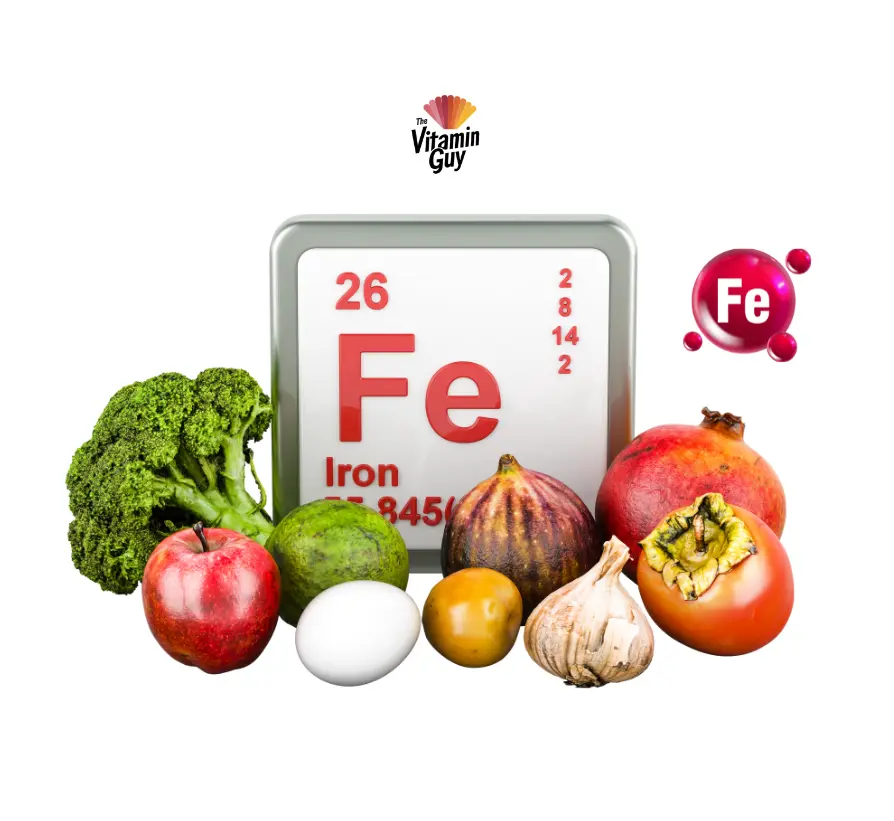
ElementIron (Fe)
Atomic number26
Food formsHaem iron and non-haem iron
Common supplement formsFerrous sulphate, ferrous fumarate, ferrous gluconate, heme iron polypeptide
⚡ What iron does
Supports oxygen transport in blood via haemoglobin.
Supports oxygen storage in muscle via myoglobin.
Contributes to energy metabolism through mitochondrial enzymes and electron transport.
Supports cognitive development, concentration, and learning.
Contributes to normal immune function.
🩸 Haem vs non-haem iron
Haem iron comes from animal foods such as red meat, poultry, and seafood. It is generally absorbed more efficiently.
Non-haem iron comes from plant foods, eggs, fortified foods, and supplements. Its absorption is more affected by meal composition, gut environment, and inhibitors such as tea, coffee, and phytates.
🇦🇺 Australian intake guide
Men: 8 mg/day
Women 19–50 years: 18 mg/day
Women 51+ years: 8 mg/day
Pregnancy: 27 mg/day
Lactation: 9 mg/day
Upper level for adults: 45 mg/day
Reality check: the right iron dose depends on the person, the cause, and the blood work. More is not automatically better.
🍽️ Absorption and bioavailability
Iron absorption is highly variable. That is why two people can eat similar food and end up with very different iron status.
May improve absorptionVitamin C, haem iron, meat-fish-poultry factor, iron deficiency state
May reduce absorptionPhytates, tea, coffee, calcium at the same meal, proton pump inhibitors, inflammation
Important nuanceNon-haem iron is more sensitive to inhibitors than haem iron
A rough rule: absorption tends to be lower in vegetarian patterns than in mixed diets, and inflammation can distort both absorption and lab interpretation.
🧠 Why iron matters clinically
Low iron does not just affect oxygen carrying capacity. It can affect concentration, work capacity, exercise tolerance, mood, and day-to-day function. In infants and pregnancy, iron status matters even more because of rapid growth and higher physiological demand.
🥩 Iron food sources
Iron can come from both animal and plant foods. Haem iron is generally easier to absorb. Non-haem iron can still contribute meaningfully, especially when paired with vitamin C-rich foods and sensible meal planning.
Food
Type
Typical serve
Approx. iron
Notes
Beef
Haem
100 g cooked
~2.5–3.5 mg
Well-absorbed compared with most plant sources.
Lamb
Haem
100 g cooked
~1.5–2.5 mg
Useful contributor in mixed diets.
Chicken thigh
Haem
100 g cooked
~1.0–1.5 mg
Lower than red meat but still useful.
Oysters / mussels
Haem-rich seafood
100 g
Variable, often high
Can be excellent sources depending on species.
Lentils
Non-haem
1 cup cooked
~3–6 mg
Pair with tomato, capsicum, or citrus to help absorption.
Chickpeas
Non-haem
1 cup cooked
~4–5 mg
Useful plant source, but absorption varies.
Tofu
Non-haem
100 g
~2–5 mg
Depends on brand and processing.
Fortified breakfast cereal
Non-haem / fortified
1 serve
Variable
Check the actual label. Fortification levels differ a lot.
Spinach
Non-haem
1 cup cooked
~3–6 mg
Contains iron, but absorption is limited by oxalates and meal context.
Pumpkin seeds
Non-haem
30 g
~2–3 mg
Good addition, not a magic fix.
Eggs
Mixed / lower absorption
2 eggs
~1–2 mg
Contributes some iron, though not the strongest source.
Values are approximate and vary by food type, cut, brand, fortification, and cooking method. The amount of iron in food is not the same thing as the amount actually absorbed.
Practical tip: pairing lentils, beans, tofu, or fortified cereals with vitamin C-rich foods such as capsicum, kiwi fruit, citrus, or tomato can improve non-haem iron absorption.
🚨 Iron deficiency vs iron overload
Iron deficiency
Iron deficiency can exist before full iron-deficiency anaemia develops. That means someone can feel awful even before haemoglobin crashes.
Fatigue or reduced stamina
Pallor
Shortness of breath on exertion
Brain fog or poor concentration
Reduced exercise tolerance
Brittle nails or hair shedding in some cases
Restless legs in some people
Groups more at risk
Menstruating women
Pregnancy
Infants and toddlers
Vegetarians and vegans
Endurance athletes
People with coeliac disease, inflammatory bowel disease, or GI blood loss
Iron excess or overload
Too much iron is not a harmless wellness strategy. The body has limited ways to actively excrete iron, so overload can matter.
High-dose oral iron can cause nausea, constipation, abdominal discomfort, or diarrhoea
Unnecessary supplementation can push iron status the wrong way
Hereditary haemochromatosis increases risk of iron accumulation
High ferritin does not always equal iron overload because inflammation can also raise ferritin
When caution is critical
Family history of haemochromatosis
Repeatedly high ferritin or transferrin saturation
Self-prescribing iron without blood tests
Do not guess: fatigue does not automatically mean low iron, and a high ferritin result does not automatically mean you are iron loaded. Context, inflammation markers, full blood count, and transferrin saturation matter.
🧪 Testing and monitoring
Iron status is not assessed well by one number alone. A decent iron work-up usually looks at storage, transport, red blood cells, and clinical context.
Test
What it helps show
Key limitation or note
Ferritin
Iron stores
Low ferritin strongly supports iron deficiency, but ferritin can rise with inflammation, infection, liver disease, and other stress states.
Full blood count (FBC)
Anaemia pattern and red cell indices
Useful, but iron deficiency can exist before anaemia shows clearly.
Transferrin saturation
Circulating iron availability
Helpful in deficiency and overload work-ups.
Serum iron
Current circulating iron
Can fluctuate and is usually not enough on its own.
CRP or inflammatory context
Whether inflammation may distort ferritin interpretation
Important when ferritin looks “normal” but clinical suspicion remains.
Haemochromatosis genetics
Inherited overload risk
Relevant in the right family or lab context.
Iron interpretation should be based on symptoms, ferritin, full blood count, transferrin saturation, inflammation status, and the likely cause of deficiency or overload. The number is only part of the story.
🔄 Interactions and practical absorption rules
Things that may help
Vitamin C with non-haem iron meals
Haem iron from animal foods
Separating oral iron from known inhibitors when appropriate
Things that may reduce absorption
Tea and coffee with the same meal
Phytates from some grains and legumes
Calcium taken at the same time in some cases
Reduced stomach acid, including proton pump inhibitor use
Medicine spacing matters
Iron supplements can interfere with the absorption of some antibiotics and other minerals such as zinc and calcium. Dose spacing matters. That is basic supplement hygiene, not optional detail.
👀 Who should pay closer attention to iron
Higher physiological demand
Pregnancy
Rapid growth in infancy and childhood
Menstruation
Potentially lower intake or absorption
Vegetarian or vegan diets without careful planning
Low-energy intake or restrictive eating
Gut disorders affecting absorption
Potentially higher losses
Heavy menstrual bleeding
Frequent blood donation
Gastrointestinal bleeding
High-volume endurance training
✅ Practical iron tips
Do not assume spinach alone will fix iron deficiency. It is not that simple.
Food iron and supplement iron behave differently, and haem iron is generally absorbed better.
If ferritin is low, the next question is why, not just what supplement.
Heavy periods, pregnancy, endurance training, and gut issues are common reasons people run low.
Do not treat chronic fatigue as “just stress” without checking basics such as iron status where clinically relevant.
What is the difference between haem and non-haem iron?
Haem iron comes mainly from animal foods and is usually absorbed more efficiently. Non-haem iron comes from plant foods, fortified foods, eggs, and supplements, and its absorption is more affected by meal composition.
Can you be low in iron without being anaemic?
Yes. Iron deficiency can exist before full iron-deficiency anaemia develops. That is one reason ferritin and broader iron studies can matter even when haemoglobin is not dramatically abnormal.
Does tea or coffee reduce iron absorption?
It can, especially for non-haem iron. Tea and coffee are best separated from iron-rich meals or iron supplements when absorption is a concern.
Should everyone with fatigue take iron?
No. Fatigue has many causes. Taking iron without checking your status first can be pointless or even harmful, especially if iron overload risk is present.
Can ferritin be misleading?
Yes. Ferritin is useful, but it also rises with inflammation, infection, liver issues, and other stress states. That is why interpretation needs context.
Who is more likely to need iron testing?
Common groups include menstruating women, pregnant women, frequent blood donors, endurance athletes, people with restrictive diets, and people with gastrointestinal conditions or possible blood loss.
📚 References and further reading
NHMRC / Australian Government. Nutrient Reference Values for Australia and New Zealand: Iron. Available at: Australian NRV Iron
NIH Office of Dietary Supplements. Iron Fact Sheet. Available at: NIH ODS Iron
TGA-compliant note: This page is educational and describes normal physiological roles, dietary sources, testing concepts, and evidence-informed safety considerations. It does not claim to diagnose, treat, cure, or prevent disease.