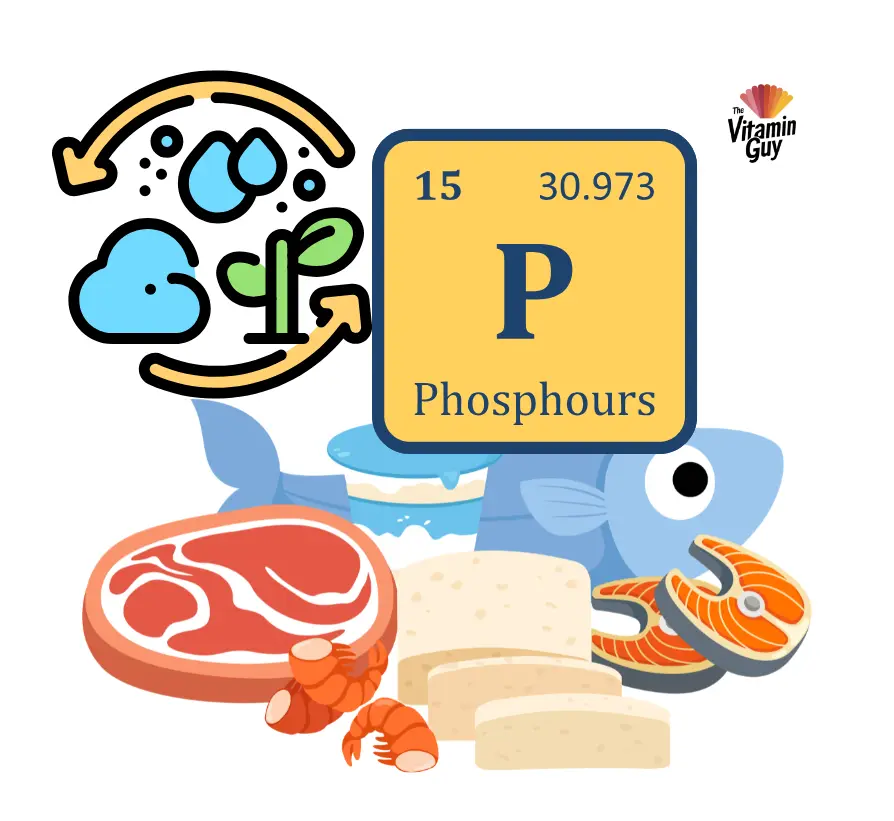
Phosphorus basics
Phosphorus is a macromineral. In the body it is mostly present as phosphate, not as free elemental phosphorus. That matters because when people talk about “high phosphorus” on blood tests or in kidney disease, they are really talking about phosphate handling.
🧬 Family & identity
Mineral classMacromineral
Element symbolP
Atomic number15
Main physiological formPhosphate (PO₄³⁻)
Where it is foundBone, ATP, phospholipids, DNA, RNA
⚡ What it actually does
- Builds hard tissue: combines with calcium in bone and teeth.
- Handles energy: part of ATP and ADP, the body’s energy transfer system.
- Supports membranes: key part of phospholipids in every cell membrane.
- Buffers acid: contributes to acid–base control, especially in urine.
- Helps signalling: phosphorylation is a core on/off switch in cell biology.
🌿 Plain-language summary
Think of phosphorus as part building material, part battery chemistry, and part cell structure. You need it, but you usually do not need more of it. In modern diets, the bigger concern is often hidden phosphate additives in packaged foods rather than low intake.
Food reality: whole foods usually come with phosphorus in a more balanced nutritional package. Processed foods can deliver a lot of fast-absorbed phosphate without much nutritional upside.
Absorption, bioavailability, and food sources
Not all phosphorus behaves the same. The source matters. Animal foods are generally well absorbed. Plant foods can contain phosphorus bound to phytate, which humans absorb less efficiently. Phosphate additives in processed foods are usually absorbed very well.
🍽️ Absorption snapshot
Adult bioavailability~55–70%
Higher absorptionAnimal foods, phosphate additives
Lower absorptionBeans, peas, cereals, nuts with phytate
Clinical cautionReduced kidney function changes the risk equation
Why additives matter: a processed food with phosphate additives may raise phosphorus exposure more than a whole food with a similar phosphorus number, because additive phosphate tends to be absorbed more efficiently.
🥗 Major food sources
- Dairy foods such as milk, yoghurt, and cheese
- Meat, poultry, seafood, and eggs
- Legumes, nuts, seeds, and whole grains
- Dark cola drinks and many convenience foods with phosphate additives
- Protein-fortified or highly processed packaged foods
Kidney warning: for people with chronic kidney disease, phosphate from processed foods can become a major problem fast. “High-protein” and “convenience” does not automatically mean “safe.”
| Food | Typical serve | Approx. phosphorus | Bioavailability notes |
|---|
| Greek yoghurt | 170–200 g tub | ~220–300 mg | Well absorbed; also provides protein and calcium. |
| Milk | 250 mL | ~220–250 mg | Common everyday source. |
| Cheddar cheese | 40 g | ~180–220 mg | Dense source; easy to overdo if portions creep up. |
| Chicken breast | 100 g cooked | ~180–220 mg | Generally well absorbed. |
| Salmon | 100 g cooked | ~220–280 mg | Good protein source; exact content varies. |
| Eggs | 2 large | ~180–210 mg | Mostly from yolk; useful mixed-food source. |
| Lentils | 1 cup cooked | ~300–360 mg | Total phosphorus can be high, but phytate lowers absorption. |
| Almonds | 30 g | ~130–150 mg | Plant-bound phosphorus; less efficiently absorbed. |
| Wholegrain bread | 2 slices | ~90–140 mg | Amount varies; some products also contain additives. |
| Processed meats / convenience foods | Varies | Variable | Can contain phosphate additives with very high absorbability. |
| Dark cola / additive-heavy packaged foods | Varies | Variable | Look for ingredients containing “phos”. |
Australian NRVs and what they mean
This is where your original block needed fixing. The adult Australian target is 1,000 mg/day, not 700 mg/day. The UL is not one number for everyone either.
🇦🇺 Adult targets
EAR (Adults)580 mg/day
RDI (Adults)1,000 mg/day
UL (19–70 years)4,000 mg/day
UL (>70 years)3,000 mg/day
👶 Life-stage highlights
- Needs rise during childhood and adolescence because of growth.
- For most adults, normal mixed diets already provide adequate phosphorus.
- Pregnancy and lactation do not automatically mean dramatically higher phosphorus needs in Australian NRVs.
📈 Quick intake reality
Hitting the phosphorus RDI is usually not difficult. A few serves of dairy or protein foods can get you there quickly. That is why deficiency from low dietary intake alone is uncommon.
Deficiency, excess, and the clinical picture
Phosphorus is one of those nutrients where the deficiency story is real but uncommon, while the excess story matters more in kidney disease and high-additive diets.
🔻 Low phosphorus (hypophosphataemia)
Diet-only deficiency is rare. When low phosphorus happens, it is often due to a medical context rather than a simple poor diet.
Possible contributors
- Severe undernutrition or prolonged very low intake
- Alcohol misuse
- Refeeding after starvation or severe illness
- Vitamin D deficiency or malabsorption
- Some endocrine or renal causes
Possible signs
- Weakness and fatigue
- Bone pain
- Muscle dysfunction
- Neurological confusion in severe cases
- Haemolysis or respiratory weakness in severe deficiency
🔺 High phosphorus (hyperphosphataemia)
High phosphorus is a bigger deal in chronic kidney disease because the kidneys cannot clear excess phosphate properly.
Why that matters
- Can pull calcium out of bone
- Can drive secondary hyperparathyroidism
- Can contribute to vascular and soft-tissue calcification
- Can increase cardiovascular risk in CKD
Blunt truth: a “healthy-looking” processed diet can still be phosphate-heavy. Kidney patients can get into trouble long before they realise it.
⚖️ Calcium–phosphorus balance
Phosphorus does not work in isolation. The clinical picture often involves calcium, vitamin D, parathyroid hormone (PTH), and kidney function. Looking at one lab number on its own can be misleading.
A normal phosphorus intake in one person can be too much in another if renal clearance is impaired.
Testing and interpretation
Serum phosphate is useful, but context is everything. A blood level is not the whole story unless you also understand kidney function, calcium handling, hormones, and the clinical situation.
🧪 What gets checked
- Serum phosphate
- Corrected calcium or ionised calcium
- PTH (parathyroid hormone)
- Vitamin D status where relevant
- Urea, creatinine, eGFR for kidney function
- Magnesium in broader mineral assessment
A commonly quoted adult reference interval for serum phosphorus is roughly 0.8–1.5 mmol/L, but ranges vary by lab, age, and clinical context.
🩺 When phosphorus deserves attention
- Known or suspected kidney disease
- Abnormal calcium or PTH results
- Bone pain, severe weakness, unexplained mineral issues
- Refeeding risk after prolonged poor intake
- Intensive care, major illness, or complex electrolyte shifts
In routine healthy adults, phosphorus deficiency is not usually the first lab problem to chase. In CKD, it absolutely can be.
Key interactions and practical cautions
🔄 Nutrient interactions
- Calcium: tightly linked in bone and blood chemistry.
- Vitamin D: helps regulate calcium–phosphorus balance.
- Magnesium: relevant in broader electrolyte and bone physiology.
- Protein intake: high-protein diets often raise phosphorus intake too.
💊 Medication / management notes
- Phosphate binders may be prescribed in CKD to reduce absorption.
- Some antacid patterns and medical treatments can alter phosphate status.
- Supplementing phosphorus casually is usually unnecessary unless specifically indicated.
🏷️ Label-reading tip
In processed foods, scan ingredients for words containing “phos” — for example phosphoric acid or phosphate salts. That is often where hidden, highly absorbable phosphorus is coming from.
Phosphorus FAQ
These are the questions people actually ask — and the answers need to be straight.
What does phosphorus do in the body?
Phosphorus helps build bones and teeth, forms part of ATP for energy transfer, supports cell membranes, and contributes to acid–base balance. It is one of the body’s core structural and metabolic minerals.
Is phosphorus deficiency common?
No. In normal mixed diets, true dietary phosphorus deficiency is uncommon. When low phosphorus shows up, there is often a bigger medical reason behind it, such as severe malnutrition, refeeding, alcohol misuse, vitamin D issues, or kidney/endocrine problems.
Can you get too much phosphorus from food?
Yes, especially from phosphate additives in processed foods. For healthy kidneys this is often tolerated better than in CKD, but in kidney disease excess phosphorus can become dangerous and contribute to bone loss and vascular calcification.
Are plant foods lower in usable phosphorus?
Often, yes. Many plant foods store phosphorus as phytate, which humans absorb less efficiently than phosphorus from animal foods or additives. That does not make plant foods “bad” — it just changes bioavailability.
Should I take a phosphorus supplement?
Usually not. Most people already get enough phosphorus from food. Supplementing without a good reason is unnecessary at best and stupid at worst, especially if kidney function is impaired.
What is the Australian RDI for phosphorus?
For adults, the Australian RDI is 1,000 mg/day. The UL is 4,000 mg/day for adults aged 19–70 years and 3,000 mg/day for adults over 70 years.
Where to go next
Want the bigger picture? Phosphorus makes more sense when you view it alongside calcium, magnesium, kidney function, hydration, and the rest of your mineral intake.
Explore more from The Vitamin Guy Learn Hub, browse the full
Minerals library, or read related pages on
Calcium and
Magnesium.
For service information, FAQs, and booking pathways across
Brisbane,
Gold Coast, and
Northern Rivers NSW,
see the links below.
Compliance note: This page is educational and uses structure/function language only. It does not diagnose, treat, cure, or prevent disease. Independent GP assessment and prescription are required where relevant to any service discussion.
References & further reading